

Target
Introduction
Naturally Fractured Reservoir Definition
Fractures Overview
Classification of Fractured Reservoir
Fractured Reservoir Recognition
Geo-modeling Overview
Fractures Intensity Modeling
Fractures Orientation Modeling
Fractures Petro-physical Characterization 1/2/3
Appendix – Some insights
Flow Simulation geologist perspective
Flow Simulation - Single Medium
Flow Simulation - Dual Media
Flow Simulation – New Frontiers
Final Considerations
Field Trip
.
Naturally Fractured Reservoirs
".... Hic Sunt Leones ! ... "
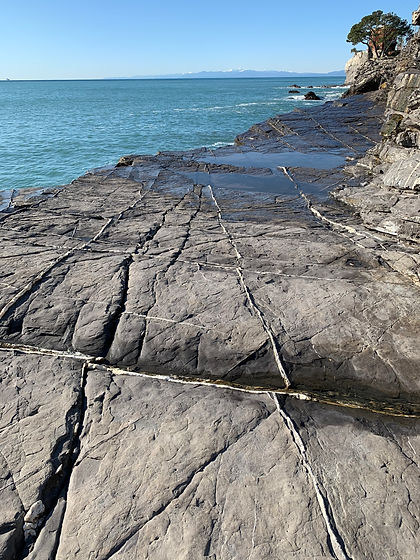
Target
Having spent a lot of time struggling with this very challenging reservoirs, I feel myself as a kind of “veteran”, rather than an expert, and I have the target, with these presentations, to discuss, or better “argue”, about naturally fractured reservoirs to share, shortly, some ideas and give suggestions to trainee on how to face the study of these reservoirs.

Fractures and Naturally Fractured Reservoirs
Introduction
Despite more than 35 years spent in the oil and gas industry, working as reservoir geologist in different geological contexts dealing mainly with very large fractured carbonate reservoirs, I see the characterization of a naturally fractured reservoir as a very intimidating and challenging task.

Naturally Fractured Reservoir Definition
The statement, “… all reservoirs contains fractures but not all are fractured reservoirs …” is a good introduction to the question: “…What is a fractured reservoir?...” This question is addressed by the simple definition: “… a reservoir in which fractures enhance the permeability at field scale, thereby significantly impacting wells productivity and recovery efficiency … “.

Fractured Reservoir Recognition
The presence of fractures in a reservoir is just a part of the story and we cannot give for granted that we are dealing with a fractured reservoir. In fact, to recognize a natural fractured reservoir we have to rely not just on the direct observations of fractures but also on the indirect observations as inferable from the dynamic behaviors that mirror the actual impact of the fractures at larger scale, at reservoir scale.

Modelling Naturally Fractured Reservoirs
Geo-modelling Overview
The building of the fractures model has the main target of estimating the fractures permeability and anisotropy to produce, by iterative tuning, the final optimized input for the Flow Simulation Model. Actually, no single typical way to model NFRs exists being strongly conditioned by the data available that are, in turn, very often linked to the maturity of the project.

Fractures Petro-physical Characterization 1
The analysis of the ratio KHWT versus KHmatrix, that is called the Flow Capacity Index (FCI), quantifies the magnitude of fracture-related flow and its variability throughout the reservoir. Therefore, the FCI analysis can represent the initial screening to understand if we are facing a fractured reservoir. Moreover, a map of the FCI values suggests whether certain areas of the reservoir are more effectively fractured than other areas and provides a semi quantitative indication of the magnitude of permeability enhancement.
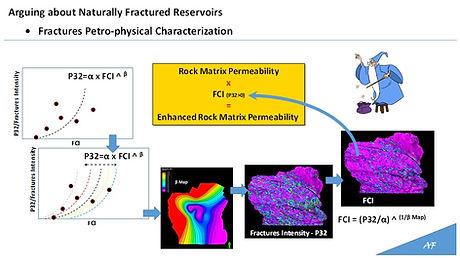
Fractures Petro-physical Characterization 2
The stresses orientation can impact on the apertures of fractures. Events parallel to the maximum horizontal stress are likely affected by a larger aperture with respect the fractures perpendicular to the maximum horizontal stress. A variation of the relationship “length vs. aperture” can be considered in relation to the fractures strike according to the increasing angle, Delta Azimuth, between the maximum horizontal stress and the fractures strike.

Flow Simulation
Single Medium
The Single effective medium approach tries to estimate a permeability enhancement in relation to the presence of fractures. So the single effective medium properties include both the permeability and porosity relevant to rock matrix and fractures. However, we have to take into account that :” fractures add permeability, they don’t multiply it”.

Dual Media
The Dual Media model approach relies on a kind of abstract idealization and simplification of the real fractures system where matrix and fractures are treated as separate entities in each cell using a “sugar cube” geometry. This approach is better in both capturing the matrix-fracture interaction and describing fracture flow channeling.

New Frontiers
The new frontiers try to move from the simplified “sugar cube” geometry to an explicit description of both the real matrix blocks and the fractures system to describe more effectively the fluid flow with a more geologically meaningful model. Waiting for the availability of this approach, not yet feasible at large field scale, some possible alternatives to the Dual Media (DM) can be considered the Clustered-Dual Media, the Embedded Discrete Fractures Model (EDFM) and the coupling of the DM with the EDFM.


Final Considerations
Integration of all the available data and skills
Fractured reservoirs are tricky and their study requires integration of all the available data coupled with creativity, guessing, imagination informed by experience to face the shortage of information and the intrinsic discontinuity and heterogeneity of the fractures network. We have to take into consideration the actual granularity of the available data and the requested details of the grid models that risk to surpass our actual knowledge.

Appendix
Some insights
Let’s try to deepen some subjects concerning the geo-modelling. In this appendix, we are going to make some additional considerations about five subjects: the modelling of the fractures density, the water saturation of the fractures, the fractures permeability calibration by WT, the building and calibration of the DFN and the sensitivities analysis by synthetic sector model.


